 Musa
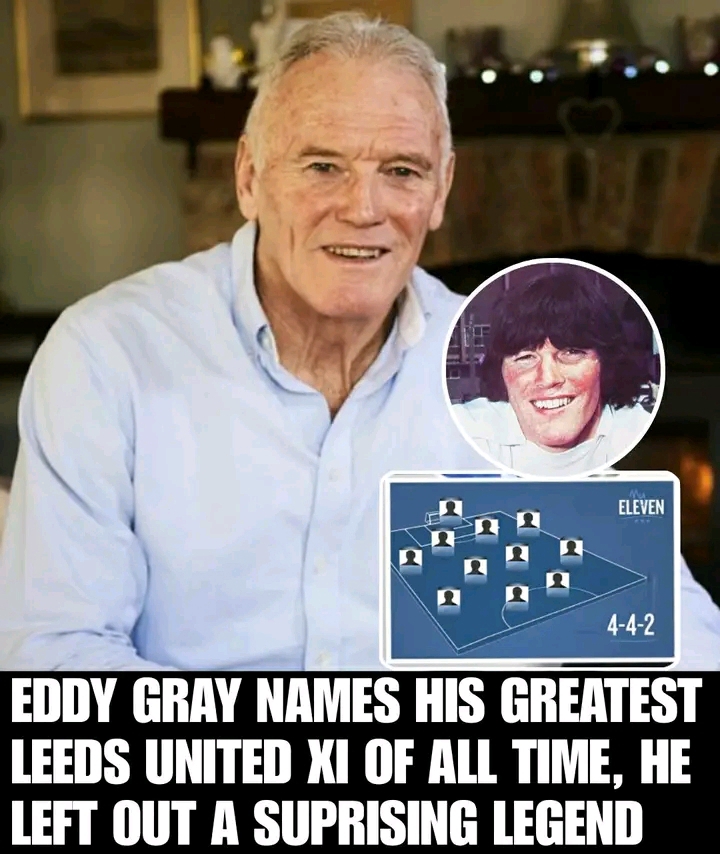
MusaIn the hallowed halls of Elland Road, where the ghosts of “The Last Waltz” still whisper and the thunder of the Revie era echoes, few voices carry the weight of Eddie Gray. A wizard on the wing, a symbol of a glorious, relentless age, and now a beloved chronicler of the club’s soul. So, when he speaks about the greatest players to ever don the famous white shirt, the entire Leeds United family leans in to listen.
Recently, the club legend was tasked with the ultimate thought experiment: to name his all-time Leeds United XI. It’s a conversation that fuels pubs and forums from Beeston to Boston, a debate steeped in nostalgia, statistics, and unwavering personal bias. For a man who played alongside gods of the game, the task was both a privilege and a minefield. The team he selected was a testament to quality, a blend of the immortal and the iconic. But it was the name he left out that sent a ripple of disbelief through the faithful, a omission that felt like removing a cornerstone from the very foundation of the club.
The Chosen Few: Gray’s Immortal XI
Before we address the shock, we must first pay homage to the magnificent eleven Gray assembled. Deploying a classic 4-4-2 formation, his team is a roll call of Leeds United royalty:
· Goalkeeper: Nigel Martyn. In choosing “Big Nige,” Gray bypassed the more decorated Pat Jennings, opting for the man whose calm, colossal presence between the posts defined the O’Leary era. Martyn was a goalkeeper of sublime consistency and breathtaking reflexes, a true great of the modern game.
· Defence: Paul Reaney, Jack Charlton, Norman Hunter, Terry Cooper. Here lies the irreducible core of Don Revie’s mean machine. This back four was not just a defensive unit; it was a statement of intent. Reaney, the relentless right-back; the towering, world-winning colossus Charlton; the fearsomely committed Hunter; and Cooper, the marauding left-back who set the template for generations. To question this defensive lineup is to question the very history of English defending.
· Midfield: Billy Bremner, Johnny Giles, Bobby Collins, Eddie Gray. The heart, soul, and genius of the team. In central midfield, Gray places the undisputed king, Billy Bremner, the fiery, incomparable leader whose passion was matched only by his technique. Alongside him, the cunning, ruthless maestro Johnny Giles, the brains of the operation. Completing the midfield is the pocket-sized dynamo Bobby Collins, whose signing ignited the Revie revolution, and on the left, the man himself, Eddie Gray, whose dribbling could demoralise an entire team in one graceful, devastating run.
· Attack: Allan Clarke, John Charles. A strike partnership of pure, unadulterated brilliance. Allan Clarke, “Sniffer,” the ultimate penalty-box predator, whose goals won cups and defined big moments. And alongside him, the gentle giant, the player many consider the most complete footballer Britain has ever produced: John Charles. “Il Gigante Buono” (The Gentle Giant) was a force of nature, equally devastating as a centre-forward and a centre-half. His inclusion is beyond debate.
It is, by any measure, a team for the ages. A side that blends granite-hard resilience with sublime artistry. Yet, for all its perfection, the absence of one man looms large, a spectral presence on the touchline.
The Shocking Omission: The Case for Peter Lorimer
The name missing from the teamsheet is Peter Lorimer.
To those who know the history, this is not just a surprise; it feels like an impossibility. Lorimer isn’t just a legend; he is an institution. He is the club’s all-time record goalscorer. He was a key component of the Revie dynasty, a player whose very name is synonymous with one thing: power.
“Hotshot” Lorimer possessed a shot that was clocked at over 80 mph, a thunderous force that terrified goalkeepers and left the woodwork shaking. His goals from midfield were a trademark of the Revie era, a crucial attacking output that complemented the guile of Giles and the tenacity of Bremner. He made 703 appearances for the club, scoring 238 goals—a record that still stands. He was there for the first division title, the FA Cup, the European finals. He was, by every quantifiable measure, a pillar upon which the club’s greatest era was built.
So, how could Eddie Gray, his teammate for over a decade, a man who shared those battles, leave him out?
The Selector’s Dilemma: Tactics, Balance, and the Unbreakable Bond
Gray’s reasoning, when examined, is not born from disrespect, but from the unenviable constraints of the exercise and a deeply personal understanding of the team’s chemistry.
The crux of the issue lies in the right-side of his four-man midfield. Gray selected Bobby Collins. To the modern fan, this may seem the more surprising choice. But for Gray, Collins was the catalyst. Before Bremner was “King Billy,” before Giles was the general, it was the signing of the veteran Scot Bobby Collins in 1962 that lit the fuse under Don Revie’s project. He was the leader on the pitch, the man who taught a talented but callow team how to win, how to fight, and how to believe. His influence was transformative. For Gray, omitting Collins would be to ignore the very spark that started the fire.
Furthermore, the balance of the team was paramount. A midfield of Bremner, Giles, Collins, and Gray is one of supreme technical control, relentless energy, and cunning game management. Lorimer, for all his incredible virtues, was a different type of player—a finisher, a force of nature, whose primary role was to arrive and unleash. In Gray’s 4-4-2, the primary goal threat is already provided by the world-class pairing of Clarke and Charles. The midfield’s job is to supply, control, and dominate.
In choosing Collins, Gray was prioritising the engine room’s architect over its most powerful cannon. He was honouring the man who built the culture over the man who so spectacularly profited from it. It was a selection based on the intangible qualities of leadership and foundational importance, as much as on pure footballing talent.
A Legacy Untarnished
Does Gray’s omission diminish Peter Lorimer’s legacy? Not in the slightest. If anything, it reinforces the almost impossible depth of quality in that legendary Revie squad. That a player of Lorimer’s stature can be left out of an all-time XI speaks volumes about the pantheon of gods he played alongside.
The debate itself is a celebration of what Leeds United has been and what its fans demand. It’s a club built on fierce loyalty, strong opinions, and an unwavering connection to its history. Eddie Gray’s team is not a definitive, objective truth—no such thing exists in football. It is one man’s deeply considered, heartfelt tribute to the men he believed formed the ultimate representation of Leeds United’s soul.
Peter Lorimer’s thunderous shot will forever echo in the memories of those who saw it. His goals are etched into the record books. And for thousands of fans, any Leeds United greatest XI that doesn’t include number 7 will always, wonderfully, be up for debate. For in the end, these conversations are the lifeblood of a great club, keeping its past alive and its legends forever on the pitch of the imagination.
