 Musa
MusaOne is the marquee signing of the January window in Scotland. So far.
The other is leading the Premiership scoring charts after netting a sensational free kick in last Sunday’s top of the table showdown at Tynecastle.
Rangers signing Andreas Skov Olsen and Celtic playmaker Benjamin Nygren both worked directly under Flemming Pedersen at Nordsjaelland on their journey that now sees them in the midst of a thrilling Scottish Premiership title race.
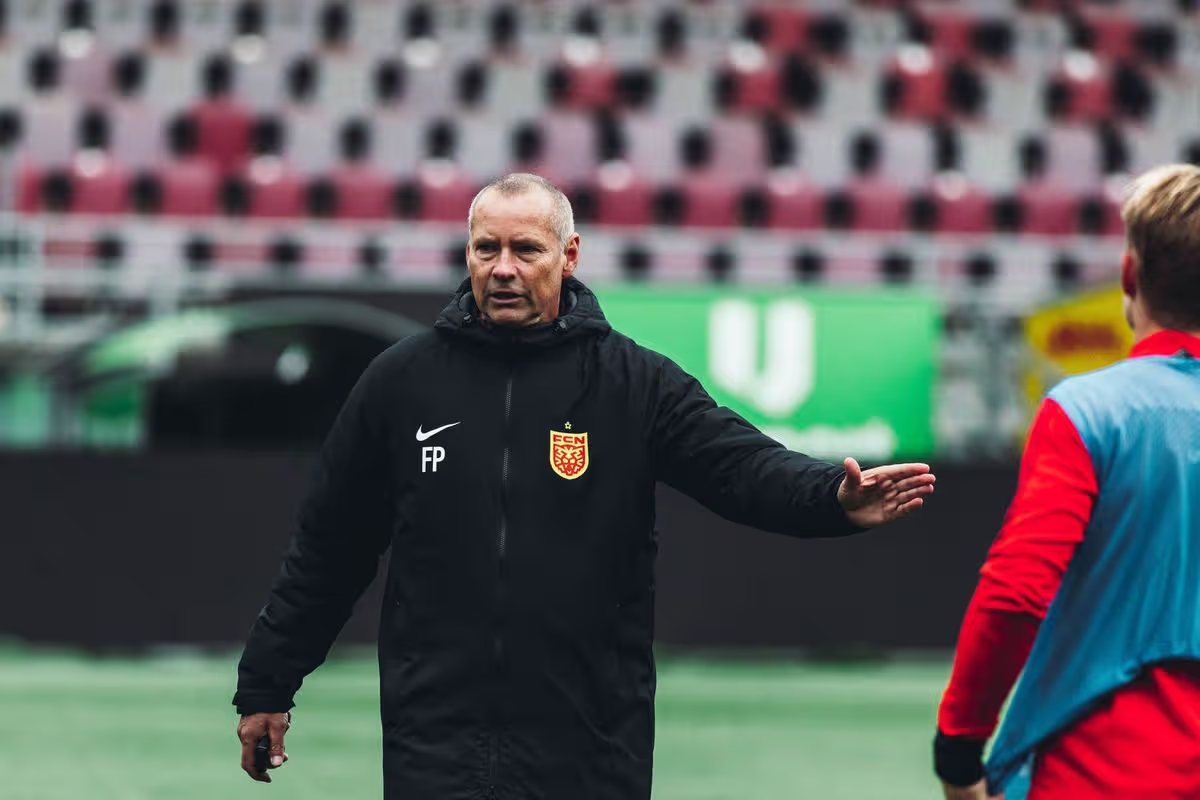
And Record Sport this week caught up with Pedersen, the technical director for both Nordsjaelland and their Right to Dream group owners, for an exclusive insight into the two men who could have a pivotal role in deciding the destiny of this season’s championship.
ANDREAS SKOV OLSEN
Adversity played a huge role in shaping Andreas Skov Olsen as a young footballer.
And Flemming Pedersen has no doubt that the winger’s loan move to Rangers can help him recover from a rocky time at Wolfsburg – and take his game onto another level at Ibrox.
Pedersen saw the development of Skov Olsen from 13-year-old wonder child to 19-year-old superstar at Nordsjaelland before the young Dane made a €5million switch to Serie A with Bologna in 2019.
The teenager’s natural talent as a silky, goalscoring winger was never in doubt.
But critical to his emergence on the big stage were two lesser known moments of pain which drew every ounce of strength and resilience out of the Danish prodigy at a time when his body and mind was still growing.
Pedersen was assistant boss to Kasper Hjulmand at the Farum-based club when Skov Olsen was emerging as the finest talent in the club’s renowned academy.
After spells at Mainz and Brentford he returned to the club as technical director in 2017 just as Skov Olsen was breaking into the first team under Hjulmand.
He then had a few months working with the winger at the end of 2018-19 season when he replaced Hjulmand as head coach before the winger made his big move to Italy on the back of a 22-goal season.
And he revealed: “The first time I noticed Andy he was 13 years old. He had arrived in FC Nordsjælland at 11 from a very small club, one of our collaboration clubs.
“I noticed him because of his dribbling skills. He was quite a tall, slim, boy, left footed, right winger.
“But his dribbling skills and then already at that time, he was very good at finishing with his left foot. We always had high hopes for him.
“But there was a change. He met adversity during the academy time in Nordsjælland, because as under-15 and under-16 player, up til under-17, he didn’t play much because he had a serious hip injury.
“He went through a big operation and then he came back late as under-17 player.
“He came back really strong. That adversity made him work even harder.
“I think it makes you aware how much you love football.
Buy a Paper
Road Record
Property
Newsletter signup
Competitions
Crossword
Horoscopes
Deals
Funeral Notices
Jobs
Advertise With Us
Sport
Football
Scottish Premiership
The difference between Nygren and Skov Olsen as Nordsjaelland chief compares Rangers new boy with Celtic star
Flemming Pedersen worked directly with the two stars currently going head to head in the three-way Scottish title race
Sport
Fraser Wilson
08:30, 01 Feb 2026
View 3 Images
One is the marquee signing of the January window in Scotland. So far.
The other is leading the Premiership scoring charts after netting a sensational free kick in last Sunday’s top of the table showdown at Tynecastle.
Rangers signing Andreas Skov Olsen and Celtic playmaker Benjamin Nygren both worked directly under Flemming Pedersen at Nordsjaelland on their journey that now sees them in the midst of a thrilling Scottish Premiership title race.
And Record Sport this week caught up with Pedersen, the technical director for both Nordsjaelland and their Right to Dream group owners, for an exclusive insight into the two men who could have a pivotal role in deciding the destiny of this season’s championship.
ANDREAS SKOV OLSEN
Adversity played a huge role in shaping Andreas Skov Olsen as a young footballer.
And Flemming Pedersen has no doubt that the winger’s loan move to Rangers can help him recover from a rocky time at Wolfsburg – and take his game onto another level at Ibrox.
Pedersen saw the development of Skov Olsen from 13-year-old wonder child to 19-year-old superstar at Nordsjaelland before the young Dane made a €5million switch to Serie A with Bologna in 2019.
The teenager’s natural talent as a silky, goalscoring winger was never in doubt.
But critical to his emergence on the big stage were two lesser known moments of pain which drew every ounce of strength and resilience out of the Danish prodigy at a time when his body and mind was still growing.
Pedersen was assistant boss to Kasper Hjulmand at the Farum-based club when Skov Olsen was emerging as the finest talent in the club’s renowned academy.
After spells at Mainz and Brentford he returned to the club as technical director in 2017 just as Skov Olsen was breaking into the first team under Hjulmand.
He then had a few months working with the winger at the end of 2018-19 season when he replaced Hjulmand as head coach before the winger made his big move to Italy on the back of a 22-goal season.
And he revealed: “The first time I noticed Andy he was 13 years old. He had arrived in FC Nordsjælland at 11 from a very small club, one of our collaboration clubs.
“I noticed him because of his dribbling skills. He was quite a tall, slim, boy, left footed, right winger.
“But his dribbling skills and then already at that time, he was very good at finishing with his left foot. We always had high hopes for him.
“But there was a change. He met adversity during the academy time in Nordsjælland, because as under-15 and under-16 player, up til under-17, he didn’t play much because he had a serious hip injury.
“He went through a big operation and then he came back late as under-17 player.
“He came back really strong. That adversity made him work even harder.
“I think it makes you aware how much you love football.
View 3 Images
Andreas Skov Olsen
“Luckily, he came back very, very strong and had a great season or two great seasons in under-19 and after the first under-19 year, we moved him to the first team, when he was 17.
“The first year in the 2017-18 season, he got his debut, but could not really get into the team.
“There were things, especially his pressing mentality, where the former head coach Kasper Hjulmand, really needed to be tough on him.
“We have always seen him as a goal scorer. But when we moved him into the first team, he had more adversity because probably he thought he would have more game time.
“And there was also a situation where he was deselected for the Danish under-19 national team in the spring 2018.
“His very, very good friend Mikkel Damsgaard from Brentford, he took his position in the Danish under-19 national team.
“That was also a good thing. That was a wake-up call for Andy that he should work even harder.
“And that’s why he went into the season like he decided in May 2018.
“He mentally decided now he needed to show what he was capable of.
“Everything exploded in the 2018-19 season, where he scored 22 goals in the Superliga and was top scorer before he was sold to Bologna in July 2019..
“He has always had a good strike. But the detail, the sharpness of his strike is now much, much cleaner.
“I became the head coach in March 2019. And I wanted to develop Andy further.
“I wanted him to play number nine, too. He had shown in a friendly how good he could be in that position.
“So to push him and develop him further, I tried to play him as a number nine.
“But I had to put him out as a winger because he didn’t see himself in a central position. And then it’s difficult to force a player to play a position where he cannot see himself.”
Rangers fans got their first glimpse of Skov Olsen in a 54 minute run out against Dundee last weekend. The club have an option to make hisloan deal permanent in the summer.
The player has already stated his desire to make that happen having fallen out of favour at Wolfsburg after his £12m move in the summer.
And Pedersen has no doubts the 40-times capped Denmark ace can reach another level in Glasgow.
He said: “Yes, definitely. It’s up to himself. And I think in a good environment that he can excel much more.
“As most other players, they need trust from the coach and the environment. He needs to play the right position.
“In Bologna, he also played wing-back. And at times also wing-back in Club Brugge, even though he did very well in Club Brugge. But he is what we call a wide winger.
“Starting wide and then he can take players on one-on-one going in, but also going on the outside because his acceleration is also world-class.
“Because he has not played much in Wolfsburg and had also had challenges in the national team, I think most people in Denmark, they can see his big, big potential.
“But the consistency, being able to show this fantastic potential again and again and again, we just need more consistency from him.
“He’s not afraid. He loves to play football. So the most important thing is that there’s trust in him. He can play for 1,000 spectators. He can play for 80,000 spectators. I really don’t think that that influences him that much. And from my part, that’s a good thing.”
BENJAMIN NYGREN
Benjamin Nygren snubbed Flemming Pedsersen and Nordsjælland in favour of Flemish Belgium and Genk as a teenager.
But such was the raw ability of the Swedish playmaker, the Danes never gave up their pursuit.
After eventually getting their man in 2022 and following a slow start to life in Farum, their patience was repaid in goals and performances that saw Nygren net 35 times in 106 appearances and thrust himself onto the international stage with Sweden before winning a £1.7m move to Celtic last summer.
But even though the 24-year-old now leads the goalscoring charts at Celtic Park – with the opener in Thursday’s 4-2 Euro win over Utrecht his 14th of the season – Pedersen can understand why the playmaker still splits opinion among the Hoops support.
There were times where he could be marked out the game or appear to slow the game down just when Nordsjaelland were needing to go through the gears in the middle of the park.
But Pedersen says the positives far outweighed the negatives.
And most importantly, he is convinced that Nygren’s professionalism and hunger to improve means he still has new levels to reach in Scotland.
He said: “We already scouted Benjamin when he was 15 years old in IFK Gothenburg. I really liked him and we tried to get him when he was 16 after he made his debut for IFK. But he went to Genk instead.
“We kept tracking him, following his development.
“And when there was an opportunity to buy him, after he was on loan in Heerenveen from Genk, then we got him on board.
“He didn’t play that much in Genk and didn’t play much in Heerenveen. So when he came to us, it took some while to get used to the intensity and to get used to our style of play.
“So he struggled a lot with the intensity and the speed of the game.
“He was on the bench, but he was born as a starting 11 player and we expected much more from him in the start.
“So it was a disappointment. But Benjamin is a very, very professional person and mentally very, very strong.
“So he just kept pushing and pushing himself.
“He just worked so hard and was very professional. And then suddenly he broke into the team and by last season was a very, very important part with 16 goals.
“At first we played him like a right winger, but also as a number nine, a dropping number nine and as a winger, like going into the right half space or the right pocket.
“We always saw Benjamin as a guy that we want on the ball. So we give him the ball and then he can make assists or be a playmaker in the last third.
“But he’s also a goalscorer.”
At the top of the Celtic midfield Nygren has continued to hit the net with big goals most recently against Utrecht and Hearts.
But in general play for a side renowned for its attacking fluency, many reckon the Swede actually slows the play down.
Pedersen said: “I can understand this because sometimes it can, it seems that he is slowing down the game because we also discussed this in Nordsjaelland.
“And also which type of games were his best. Playing against an opponent that’s marking very close, that’s playing much like man to man, he was not the best in the Superliga.
“But against teams that were more zonal, then he was very, very good.”
“We saw him best as an offensive midfielder. Or as a winger going in. I see him in the right half space, not on the last line, but in between the lines to the right.
“He’s only 24 and there’s lots of growth in Benjamin. When you’re as professional as he is, like taking care of yourself, always wanting to learn, then obviously you will get better.
“And he’s that type. He loves the game and he’s extremely competitive, loves to win, not only in football, but if you’re playing table tennis, golf, handball, everything, because he could, I guess he could do other sports.
“He chose football, but he could do several other sports and be very successful in them too.”
RIGHT TO DREAM
Flemming Pedersen has been Technical Director of the Right to Dream group since 2023.
Named Best Academy by the Globe Soccer Awards last year the group has evolved from its beginnings in Ghana in 1999 to opening academies in Denmark, Egypt and San Diego.
Spurs superstar Mohammed Kudus, Manchester United ace Patrick Dorgu and Sunderland’s Simon Adingra are among the top names to have recently come off the production line of talent.
There might not be a Scottish arm to the group yet.
But that doesn’t mean the reach of Right To Dream hasn’t touched Glasgow. And Rangers to be precise.
The arrival of Andreas Skov Olsen at Ibrox takes the number of Right to Dream products in Govan to four alongside Mohamed Diomande, Oliver Antman and Tochi Chukwuani.
It’s no wonder Rangers fans are taking a keen interest in the workings of the group who bought over FC Nordsjaelland a decade ago.
But what’s the secret to their success? According to Pedersen, it’s the fact there are NO secrets.
He said: “It’s pretty simple. First of all, we have no secrets and we are happy to tell everything.
“We are open about everything. And maybe that could be a secret because we have so many visitors worldwide and we hear from all our visitors. How can you be that open?
“Because they can come into our analysis sessions. They can see our playbook, the way we work.
“We haven’t seen that much curiosity from Scotland. But from the the Scottish FA Chris Docherty, he knows what it is going on and is very curious about what we are doing.
“We tell visitors everything. So maybe that’s the secret – that we are totally open about everything.
“And that makes people relax.
“But to be more specific, our environment is the foundation and is built on psychological safety and trust.
“So when you face this or as soon as you are part of this environment, when you are 10 years old, then this environment makes you relax.
“You give yourself to the environment, you give yourself to the collective. So that means that your ego is not in the way.
“You surrender yourself to the environment because we know we are here to help each other.
“We are not here to fight each other or to compete against each other.
“We are here to compete, but competing with each other with the purpose of helping each other to be better.
“And this is a huge difference from many other academies.
“Then, secondly, we have our style of play. We know exactly how we want to play the game. We know exactly how we want to develop players.”
And this is where the coaching buffs’ ears might prick up.
Pedersen said: “For us, the players are never in the centre. We always hear this: the player needs to have good development and the player needs to be in the centre of it.
“No, the environment, the culture and the style of play is always in the centre.
“So again, you give yourself to the collective part and then the collective part will develop you to be an individual, very, very strong person, not only player, but person with a lot of independence and a lot of integrity.
“It’s a style where initiative and intensity are two key words.
“In possession, we want to take initiative on the ball and we want to solve the different football problems.
“When we are under pressure, then we try to play out of this pressure. We try to solve the different football problems instead of just kicking away the ball.
“So decision making, we have a high, high focus on decision making because football is a cognitive sport.
“We need to teach decision making and that can only be done by solving the different football problems.
“We are not afraid of making mistakes. On the contrary, mistakes help us be even better.
“Out of possession, speaking about initiative, then we want to be on the front foot, high pressing, making traps.
“We position ourselves like in between the opponents, again to teach anticipation and decision making, not following an opponent, because that will make our players, as we call them, more stupid.
“We want our players to read the game.
“So in our own half, we always force inside because we don’t want to give away set pieces, corners, throw-ins.
“We want to keep the ball in play. And also by forcing inside, there’s a bigger chance that you win the ball central. And everyone knows that if you win the ball central in the middle of your own pitch, that will be statistically, that will give you the best chance to score on a counterattack.
“So our game model is very calculating. But the purpose is not only to win games, but to do the best development for the individual player in a very, very collective context.”
Should we expect to see more products of Right to Dream and Nordsjaelland in Scotland?
Pedersen said: “That’s a really good question.
“I can only say that most of our players are well educated in playing the game and are cognitive strong.
“We will have to see if the trend will continue. Maybe it’s just coincidence.
“But it’s fun to see four of our academy graduates in the same team in Scotland and I wish them well.”

 Musa
Musa